The masala dabba starter kit: seven spices for Bangladeshi home cooking
One round steel tin, seven little bowls, and most of the Bangladeshi weeknight repertoire within reach. Which spices go in first, what each one actually does, how to keep them fresh, where to buy them in the UK, and two quick ways to use every one.
By S&T
18 September 2026 · 14 min read
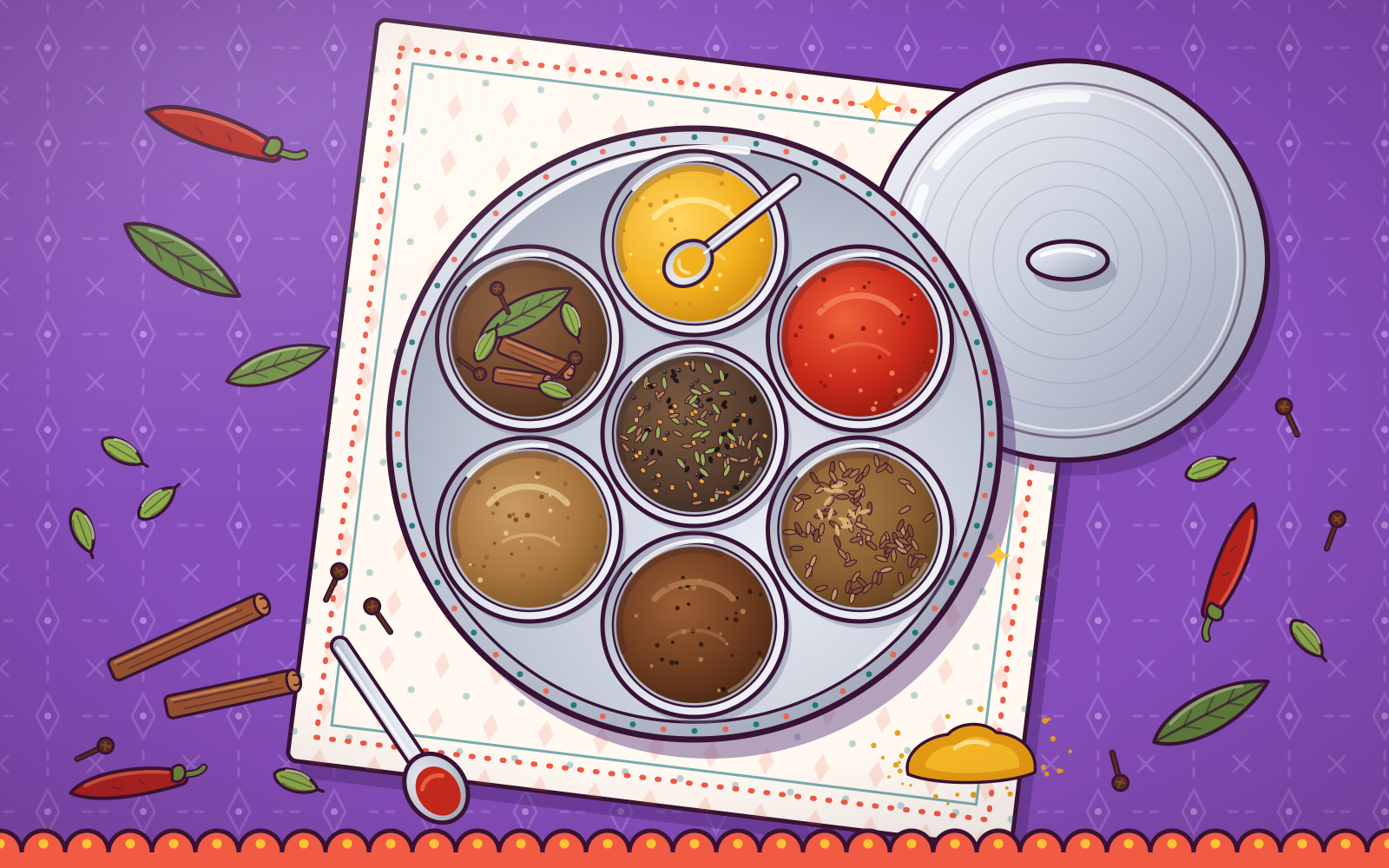
A masala dabba is a round tin, usually stainless steel, with a tight lid and a set of small bowls inside. Most have seven. It lives next to the hob, and it means the spices you reach for every day are open, together and one spoon away, instead of hiding in nine half-empty bags at the back of a cupboard. If you're starting to cook Bangladeshi food at home, it's the single most useful piece of kit you can buy, and it costs less than a takeaway.
S here, first. My mum's dabba sat to the left of her hob for my whole childhood, on a patch of worktop that had gone permanently yellow underneath it. The lid was so tight that only she could open it. She did it without looking, with the heel of her hand, halfway through a phone call, while I stood next to her losing a fight with the same tin because I needed a teaspoon of cumin for a food tech lesson. Twenty-odd years later I can open it. Not as smoothly.
T, taking over. I didn't grow up with a dabba at all. In our house the spices lived in a cupboard of mismatched jars, some still wearing old jam labels, with the real contents written on masking tape in my mum's handwriting. It worked because Mum knew every jar by its colour through the glass. The rest of us opened lids and sniffed, and occasionally put cinnamon in something that did not want cinnamon.
We share one dabba now, in a kitchen that is mostly a corridor with a hob in it. S also owns a second, smaller tin for what S calls "projects". That one holds smoked paprika, sumac and a bag of something from a market abroad that neither of us can identify. It is not part of this guide.
The hard part isn't buying the tin. It's deciding what goes in it. Seven bowls sounds like plenty until you count how many spices a curry recipe lists. So here is a starter set chosen for Bangladeshi home cooking: the seven that, between them, cover dal, bhaji, fish, chicken and meat curries, rice and a good chunk of everyday cooking.
TSeven bowls, and you've put four spices in one of them.
SThe whole spices share a room. It's a Bangladeshi household. Nobody gets their own bedroom.
The seven, at a glance
- Turmeric (holud), ground: colour, earthiness, and the base of almost everything.
- Chilli powder (morich gura): heat and colour.
- Cumin (jira), whole seeds: warm, nutty, for tempering and for roasting and grinding.
- Coriander (dhonia), ground: body and a soft, citrusy depth for curries.
- Panch phoron: the Bengali five-seed mix, for dal and vegetables.
- Garam masala, ground: the warm, fragrant finish.
- Whole spices (gota gorom moshla): bay leaves, cinnamon or cassia, green cardamom and cloves, for the start of curries and rice.
1. Turmeric (holud)
Ground turmeric is the quiet workhorse. It gives curries and dal their golden colour and a warm, slightly bitter earthiness that you notice more when it's missing than when it's there. You rarely need more than ½ to 1 tsp for a pot that feeds four. Too much tastes dusty and medicinal, so measure it rather than shaking it.
- Fish fry (mach bhaja): rub 4 fish steaks or fillets with ½ tsp turmeric, ½ tsp chilli powder and ½ tsp salt. Leave for 10 minutes, then shallow fry in hot oil for 3 to 4 minutes a side, depending on thickness, until golden and the flesh flakes easily.
- Everyday dal: add ½ tsp turmeric to 200g rinsed red lentils as they simmer. There's a full recipe below.
2. Chilli powder (morich gura)
Chilli powder brings heat and a red colour to the gravy. The heat varies a lot between brands and types: plain "hot" chilli powder can be fierce, while Kashmiri chilli powder is milder and gives more colour than fire. If you're new to a bag, start with half the amount the recipe says, taste, and build up. Note that it's different from the "chili powder" blends sold for chilli con carne, which contain cumin, oregano and garlic.
- Egg bhuna: boil 6 eggs for 9 minutes, peel and score them. Fry a sliced onion in 3 tbsp oil until golden, add 1 tsp ginger-garlic paste, ½ tsp turmeric, 1 tsp chilli powder and 1 tsp ground coriander with a splash of water, cook until the oil separates, then add the eggs and 150ml water and simmer for 5 minutes.
- Spiced potatoes: toss 600g potatoes, cut into 3cm chunks, with 2 tbsp oil, ½ tsp chilli powder, ½ tsp turmeric and ½ tsp salt. Roast at 200°C (180°C fan), gas 6 for 35 to 40 minutes, turning once, until crisp at the edges.
3. Cumin (jira)
Keep cumin whole in the dabba. Whole seeds go into hot oil at the start of a dish, where they sizzle and turn nutty within seconds. And when you want ground cumin, roasting whole seeds and grinding them yourself gives a far deeper flavour than a bag of ready-ground. If you'd rather keep a jar of ground cumin too, it lives happily in the cupboard.
- Jeera rice: heat 1 tbsp oil or ghee, add 1 tsp cumin seeds and let them sizzle for 20 to 30 seconds, then stir in 300g rinsed basmati, 450ml water and ½ tsp salt. Bring to the boil, cover, and cook on the lowest heat for 12 minutes, then rest, covered, for 10.
- Roasted cumin (bhaja jira gura): toast 2 tbsp seeds in a dry pan over a medium-low heat for 2 to 3 minutes, shaking, until a shade darker and fragrant. Cool, then grind. Sprinkle a pinch over bhorta, yoghurt, raita or fruit chaat.
4. Coriander (dhonia), ground
Ground coriander seed is mild, slightly citrusy and a little sweet, and it gives a curry body. It's the bulk spice: where a recipe uses ½ tsp of turmeric, it might use 2 tsp of coriander. It loses its fragrance faster than most, so buy small bags and refill often.
- Curry base: for a chicken or meat curry for four, mix 2 tsp ground coriander, 1 tsp ground cumin, ½ tsp turmeric and 1 tsp chilli powder with 3 tbsp water into a loose paste. Fry it in the oil after the onions and ginger-garlic for 2 to 3 minutes, until the oil separates, before the meat goes in.
- Keema: add 2 tsp ground coriander with the other spices when browning 500g minced lamb or beef. Simmer until the mince is cooked through, with no pink left.
5. Panch phoron
Panch phoron means "five spices", and it's the most Bengali thing in the tin. It's a whole-seed mix, usually equal parts of fenugreek, nigella (kalonji), cumin, fennel and black mustard seeds. Some cooks swap the mustard for radhuni, a small seed related to celery. Fried in oil for a few seconds, it pops and crackles and turns plain dal, potatoes or a pan of vegetables into something with real character.
- Dal tarka: the recipe below is built on it.
- Panch phoron potatoes (aloo bhaji): heat 3 tbsp oil, add 1 tsp panch phoron and 2 dried red chillies, and as soon as the seeds pop, add 500g potatoes cut into 1.5cm cubes, ½ tsp turmeric and ¾ tsp salt. Cover and cook on a medium-low heat for 15 to 20 minutes, stirring now and then, until tender and catching at the edges.
6. Garam masala
Garam masala is a ground blend of warming spices. Bangladeshi blends tend to lean on cinnamon, cardamom and cloves, sometimes with bay, black pepper, nutmeg or mace. It's a finishing spice: a pinch near the end of cooking lifts a curry's aroma. Added at the start, most of that fragrance cooks away.
- Finish a curry: stir ½ tsp garam masala into a pot of meat or chicken curry for four in the last 5 minutes.
- Keema or chicken roast: add ½ tsp to the spices for 500g mince or 1kg chicken, and scatter a pinch more over just before serving.
This is the one bowl we disagree about. T buys garam masala, a decent bag from the grocer, finishes it in a couple of months and sees no problem. S makes it, in small batches, and will tell you about the smell of a freshly ground jar whether you asked or not. Both approaches make good curry. Here is S's version, if you want to try it.
S's small-batch garam masala (makes about 2 tbsp)
- 2 cinnamon sticks or pieces of cassia bark, about 5cm each, broken up
- 1 tbsp green cardamom pods
- 1 tsp cloves
- 1 tsp black peppercorns
- 2 Indian bay leaves (tej pata), torn
Toast everything in a dry frying pan over a low heat for 2 to 3 minutes, shaking the pan, until the cardamom smells sweet and the cloves look slightly glossy. Tip it onto a plate and let it cool completely, then grind to a fine powder in a spice grinder. Sieve out any stubborn bits of cardamom husk if they bother you. Keep it in a small airtight jar, and use it within a couple of months, while it still smells the way it should.
TCan we mention that the spice grinder used to be our coffee grinder?
SAnd now it's a much better spice grinder. The cardamom flat white was a one-off.
TIt was a one-off because I refused to drink a second one.
7. Whole spices (gota gorom moshla)
This bowl holds the whole spices that go into hot oil at the start of meat curries, kormas and rice: bay leaves (tej pata), sticks of cinnamon or cassia bark, green cardamom pods and cloves. They're not meant to be eaten. They flavour the oil and the gravy, then get left on the side of the plate. Snap the cinnamon into 3 to 5cm pieces so it fits the bowl.
- Polao: fry 1 bay leaf, a 4cm piece of cinnamon, 3 cardamom pods and 3 cloves in 2 tbsp ghee or oil with a sliced onion before adding the rice and water.
- Curry starter: add the same set to the oil for 30 seconds before the onions go into almost any meat curry, such as Sylheti shatkora beef or chicken roast.
Choosing a dabba
- Stainless steel is the classic: it doesn't stain, it's easy to wash and it lasts for decades.
- Look for a snug lid. Many have an inner glass or steel lid as well as the outer one, which keeps out more air.
- Size: a tin around 18 to 20cm across holds seven bowls that are big enough for a week or two of cooking.
- Small spoons usually come with it. One per bowl is luxury. One shared, wiped dry between spices, is normal.
Storing spices so they stay good
- Heat, light, air and steam are the enemies. Keep the dabba near the hob, but not on the back of it or directly above the steam from your pans.
- Fill the dabba little and often. Keep the rest of each bag sealed in a jar or clip-closed in a cool, dark cupboard, and top up from there.
- Use a dry spoon, always. A wet spoon puts damp into the bowl, and damp spices clump and spoil.
- As a rule of thumb, ground spices taste best within about 6 months of opening, and whole spices within a year or so. They don't become unsafe after that, they just fade. If it barely smells when you rub a pinch between your fingers, it's time for a new bag.
- Empty and wipe the bowls every few refills, so old spice doesn't sit at the bottom under new.
Where to buy in the UK
- South Asian grocers: the best value by far, with bigger bags, whole and ground versions of everything, ready-mixed panch phoron and Indian bay leaves. Most also sell steel masala dabbas.
- Big supermarkets: the world food aisle usually stocks larger, cheaper bags than the small jars in the main spice aisle.
- Online: useful for panch phoron, radhuni or a dabba if there's no grocer near you. Compare the price per 100g, not per bag.
- Buy bags you'll finish. A huge bag is only cheaper if you use it before it fades.
We buy nearly all of ours from the Bangladeshi grocer a few minutes' walk away: spices on the top shelf, two chest freezers full of fish, and always somebody at the till with a 10kg sack of rice on their shoulder. We're not naming it. It wouldn't help unless you live on our road, and the owner would never let us hear the end of it. Your nearest one will do the job just as well. Go for 100g or 200g bags rather than the kilo ones, tempting as the price is. A kilo of ground coriander is a long relationship, and it stops smelling of anything well before the end.
When we put a dabba together for T's cousin as a moving-in present, the steel tin and seven small bags came to a little over £20. Your total will depend on the shop and the tin, but it's closer to the price of a takeaway than a kitchen gadget.
What's actually in our dabba
Confession: ours doesn't follow this list to the letter. The garam masala lives in a jar in the cupboard, because S keeps making fresh batches and refuses to let them sit open by the hob. Its bowl went to dried red chillies, which we use nearly every day, and which, as you'll see in a minute, the dal below needs. The bay leaves have also been moved out of the whole spices bowl into a jar of their own. They kept sliding out across the worktop every time the lid came off.
That's the point, really. Start with the seven above, cook from it for a month, and then let your own cooking rearrange it. Whatever you keep refilling earns a bowl. Whatever is still full at the end of the month can go back in the cupboard.
Your first cook: masoor dal with a panch phoron tarka
If you buy a dabba and fill it this week, make this first. It uses four of the seven bowls, takes about 40 minutes, and is the everyday dal of many Bangladeshi homes: thin enough to pour over rice, golden, and finished with a sizzling tarka of panch phoron, chilli, onion and garlic.
Ingredients (serves 4)
- 200g red split lentils (masoor dal)
- 900ml water, plus a splash more if needed
- ½ tsp ground turmeric
- 1 tsp salt, plus more to taste
- 2 tbsp neutral oil, or ghee
- 1 tsp panch phoron
- 2 dried red chillies
- 1 bay leaf
- 1 small onion (about 120g), thinly sliced
- 3 garlic cloves, thinly sliced
- ¼ tsp chilli powder
- A small handful of coriander, chopped
- A squeeze of lime, to serve (optional)
Method
- Put the lentils in a sieve and rinse under cold water, rubbing them with your fingers, until the water runs much clearer.
- Put the lentils, water and turmeric in a medium saucepan and bring to the boil. Skim off any foam, then turn down to a gentle simmer. Cook, partly covered and stirring now and then, for 20 to 25 minutes, until the lentils have completely collapsed.
- Whisk the dal for 30 seconds to make it smooth. Stir in the salt. It should be pourable, like thin soup; add a splash of hot water if it's too thick. Keep it on the lowest heat.
- For the tarka, heat the oil or ghee in a small frying pan over a medium heat. Add the panch phoron, dried chillies and bay leaf. Stand back slightly: the seeds will pop. Fry for 20 to 30 seconds, until the seeds crackle and the fenugreek turns a reddish-brown. Don't let them go black or they'll taste bitter.
- Add the onion and fry for 5 to 6 minutes, stirring, until golden brown.
- Add the garlic and fry for 1 minute more, until just golden. Take the pan off the heat and stir in the chilli powder.
- Tip the tarka into the dal. It will sizzle loudly, so pour it away from you. Stir, simmer for 2 minutes, then taste for salt.
- Scatter over the coriander, add a squeeze of lime if you like, and serve with plain rice.
What we learned making it
We made this dal four times while writing this guide, which is four more times than either of us had ever measured a dal at home. The quantities above are the ones that held up. A few notes from those evenings.
- Watch the fenugreek. On our second go, S turned round to answer the door, and in the time it took to sign for a parcel the seeds went from reddish-brown to black. The dal tasted faintly of bonfire. Take the pan off the heat as soon as the crackling settles. If anything does turn black, wipe the pan and start the tarka again. It costs you a teaspoon of seeds and saves the whole pot.
- Thickness is a household argument. T likes it thin enough to drink from a cup. S likes it thick enough to hold a ridge in the rice. 900ml of water is our truce. It thickens as it sits, so loosen leftovers with a splash of hot water when you reheat them.
- Salt after the lentils have collapsed, not before. We tried both, and the early-salted pot took noticeably longer to break down. It might have been the lentils that week, but salting at the end is easier to judge anyway.
S has also tried splitting the tarka: half stirred in at step 7, half kept back and spooned over each bowl at the table so it still crackles. It is better. It is also one more pan, and S already has a reputation for that, so we've left it as an optional extra.
Cooking safely
- Hot oil and whole seeds spit. Use a pan with sides, keep your face back, and never leave hot oil unattended.
- If oil ever catches fire, turn off the heat and cover the pan with a lid or a damp tea towel. Never use water.
- Cooked rice can carry spores that survive cooking. If you're keeping leftovers, spread the rice out to cool and get it into the fridge within 1 hour, eat it within 24 hours, and reheat it only once, until piping hot.
- Cool leftover dal quickly, refrigerate within 2 hours and eat within 3 days. Reheat until steaming hot all the way through.
- Chicken and other poultry must reach 75°C in the thickest part, with no pink meat and juices running clear, whichever spices you use.
What we'd add next
TSmall point. The first recipe in your starter kit uses a spice that isn't in the starter kit.
SDried chillies. Which is why they're top of the next list.
TSo the starter kit comes with a sequel. Convenient.
- Dried red chillies: whole, for tarkas, aloo bhaji and the dal above. They keep well, and two in hot oil do more than you'd expect.
- Nigella seeds (kalonji): already in panch phoron, but on their own they're lovely in a tarka for fish or a simple vegetable bhaji.
- Black peppercorns: for S's garam masala, and a few in the oil with the whole spices when you make polao.
- Kasuri methi (dried fenugreek leaves): crumble a pinch between your palms into a chicken curry in the last few minutes. It smells like a restaurant kitchen in the best way.

Cook it with Jan
Want to make bangladeshi masoor dal with panch phoron tarka tonight? Jan will scale it for your crowd and walk you through every step.
- Masala dabba
- Spices
- Bangladeshi recipes
- Panch phoron
- Store cupboard
- Beginner cooking
- Dal
- Garam masala
About the authors
The couple behind Kookbook
Married, British Bangladeshi, and usually arguing about the correct amount of chilli. We test the recipes the internet won't stop talking about, work out what actually tastes good, and share the version we'd make again.