Masala chai and nimki: the after-hours ritual
A pan of spiced milky tea and a plate of flaky, diamond-cut nimki: the snack that turns a late night into a proper sit-down. Both recipes, how to deep-fry safely at home, and how to make a batch that lasts the week.
By S&T
4 November 2026 · 12 min read
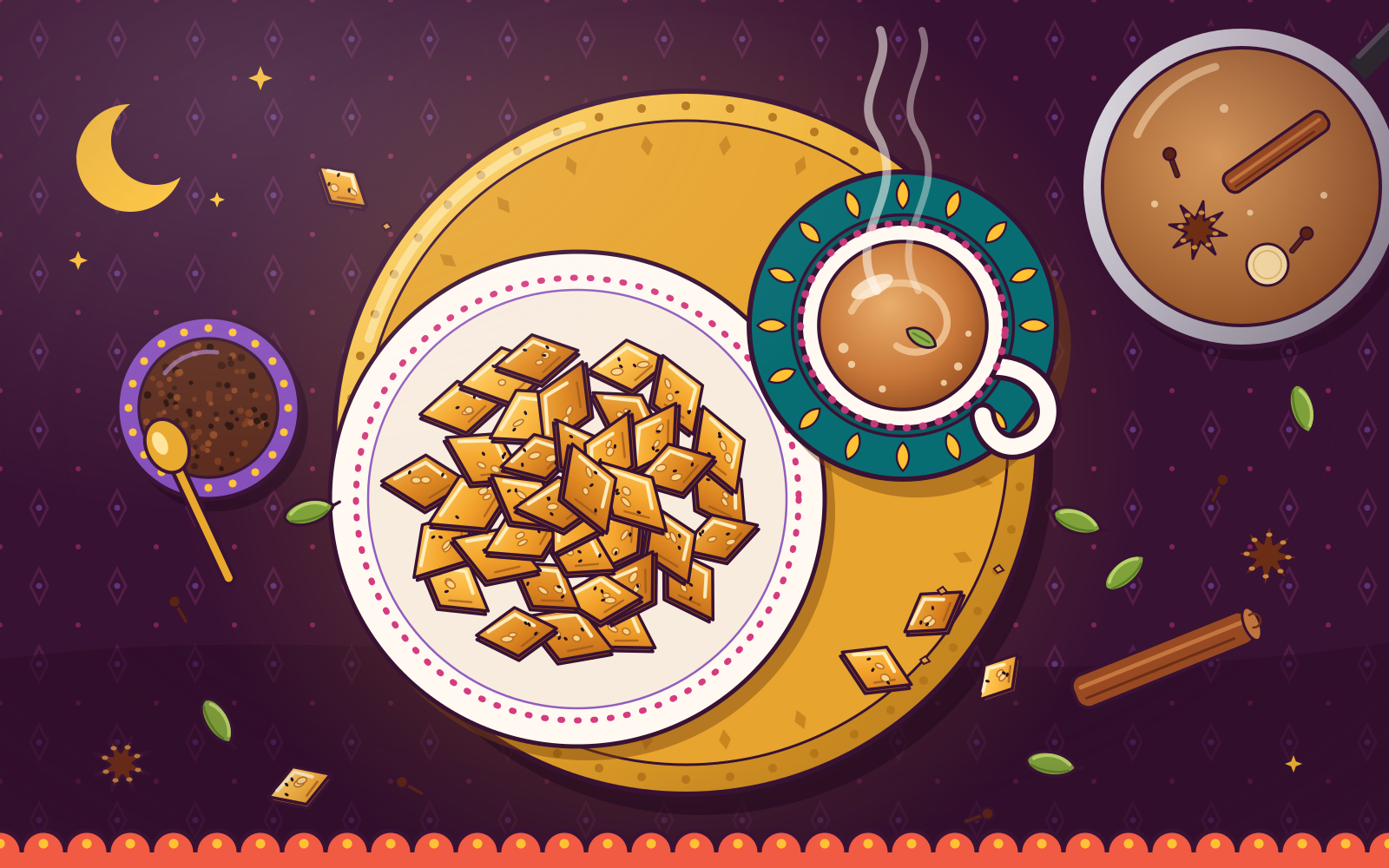
Some snacks are a meal. Nimki is a conversation. Small, salty diamonds of fried dough, flaky and shatter-crisp, flecked with black nigella seeds, kept in a tin and brought out whenever the kettle goes on. Pair it with masala chai simmered in a pan with cardamom, cinnamon, cloves and ginger, and you have the most Bangladeshi way there is to stay up too late.
In our flat, after hours starts at about half ten. T has a bundle of papers spread across the sofa that was supposed to be finished at six. S has a laptop open with a problem on it that was supposed to be finished at five. Neither of us says anything. Then one of us gets up, and the other hears the small milk pan come out of the cupboard, the dented one with the wobbly handle that we've been told to replace at least once a month by everyone who visits. That's the signal. Ten minutes later the whole kitchen smells of cardamom and someone is prising the lid off a tin.
The tin matters. In T's mum's house it was a blue Danish butter cookie tin that has never, in living memory, contained a single butter cookie. It held nimki, and occasionally sewing things, and you only found out which when you'd already got your hopes up. Nimki got made in big batches when guests were expected, usually on a Saturday morning with the radio on, and whatever survived the guests went into the tin for the week. Coming home late from uni and finding it half full was its own kind of welcome.
S grew up with nimki too, but the shop kind, in a plastic bag twisted shut with a peg. Perfectly good. Slightly too hard. S didn't know nimki could be flaky until the first time T's mum handed over a plate of homemade ones, at which point S ate about fifteen and then asked, in front of everyone, what the ratio of fat to flour was. T's mum looked at S as if S had asked for the Wi-Fi password to her soul.
TShe told you "enough ghee". That was the whole answer.
SWhich is why this post has numbers in it. Fifty grams. I weighed it.
TAfter she'd gone home.
SAfter she'd gone home, yes. I'm brave, not stupid.
What makes nimki flaky
- Moyan. Rubbing fat (ghee or oil) into the flour before adding water is what makes nimki flaky rather than hard. Squeeze a handful of the mixture: it should hold its shape like damp sand.
- A stiff dough. Add the water a little at a time. A soft dough makes chewy nimki that soak up oil.
- Thin, but not paper-thin. Roll to about 2 to 3mm. Thinner burns; thicker stays doughy in the middle.
- Prick it. A few fork holes stop the pieces puffing up like little pillows.
- Low and slow. Fry at around 160 to 170°C. Too hot and they brown outside while staying soft inside. Patience is the whole trick.
Nimki ingredients (makes about 60 pieces, serves 4 to 6 with chai)
- 250g plain flour, plus a little for rolling
- ½ tsp fine salt
- ½ tsp nigella seeds (kalonji)
- ¼ tsp ajwain (carom seeds), crushed between your fingers (optional)
- 50g ghee, melted, or 4 tbsp neutral oil
- About 100ml cold water
- Neutral oil with a high smoke point (sunflower, rapeseed or vegetable), for deep-frying: about 1 litre, depending on your pan
Making the nimki
- Mix the flour, salt, nigella seeds and ajwain in a large bowl. Pour in the melted ghee or oil and rub it into the flour with your fingertips for 2 to 3 minutes, until it looks like breadcrumbs and holds together when you squeeze a handful.
- Add the cold water a few tablespoons at a time, bringing the dough together with your hand. Stop as soon as it forms a firm, stiff dough. You may not need all of it.
- Knead for 2 minutes until smooth-ish (it won't be silky, and that's fine). Cover with a damp tea towel or cling film and rest for 20 to 30 minutes.
- Divide the dough into 4 balls. Roll one out on a lightly floured surface to a rough circle about 2 to 3mm thick. Keep the others covered.
- Prick all over with a fork. Cut into parallel strips about 2.5cm wide, then cut across them at an angle to make diamonds. The odd-shaped edge pieces are the cook's perk.
- Pour oil into a deep, heavy pan to a depth of about 5cm, no more than a third full. Heat over a medium heat to 160 to 170°C. With no thermometer, drop in one piece: it should sink, then rise slowly with gentle, steady bubbles. If it rises instantly and browns, the oil is too hot.
- Fry a handful of pieces at a time, without crowding, for 5 to 7 minutes, turning them now and then with a slotted spoon, until pale golden and crisp and the bubbling has slowed right down. Turn the heat down a little if they colour quickly.
- Lift out onto a tray lined with kitchen paper. Let the oil come back to temperature, then fry the next batch. Roll and cut the next ball while each batch fries, if you're comfortable doing both at once. If not, roll everything first.
- Leave the nimki to cool completely. They crisp up further as they cool.
How our batches actually went
We made nimki four times for this post, across two weekends, which is more nimki than two adults should have in a flat at once. Our downstairs neighbour now has a jar. She didn't ask for a jar.
Batch one was a lesson in rolling. T rolled, S fried, and T, in a hurry and slightly offended by the idea of a ruler, left the dough closer to 5mm than 3. The nimki puffed into little cushions, browned beautifully on the outside and were still pale and bready in the middle. They tasted like a nice cracker that had given up halfway. Rolled properly thin, to roughly the thickness of a pound coin, the second lot came out layered and crisp all the way through. That's why the recipe says 2 to 3mm and means it.
Batch two was ghee against oil, side by side, same everything else. Both were flaky. The oil ones were very slightly crisper and stayed that way a day longer in the tin. The ghee ones tasted richer, rounder, more like home. T wouldn't go back. S, whose spreadsheet brain notes that oil is cheaper and the difference is small, makes them with oil midweek and keeps quiet about it. Either works, so the recipe gives you both.
Batch three is the one we don't talk about. S, feeling confident, decided to roll the next ball while the first lot fried, turned round to cut the diamonds, and the oil quietly crept up to about 185°C on the clip-on thermometer. By the time the diamonds were cut, a whole handful had gone well past golden to dark brown. They tasted bitter and faintly of regret. If you're not used to frying, roll and cut everything before the oil goes on. It adds ten minutes and takes away all of that.
On our hob, at a steady 165°C, each batch took a little over 6 minutes. You'll hear it before you see it: the bubbling is loud and busy when the pieces go in, then thins out to a lazy fizz when the water has cooked out and they're done. And the ajwain? T's mum doesn't use it. S insisted on trying it and it's lovely, a thyme-ish, slightly medicinal warmth that sits nicely next to the nigella. Just don't go over a quarter of a teaspoon, or it starts tasting like a cough sweet. It stays optional.
STo be clear, the thermometer is why batch four was perfect.
TThe thermometer was also there for batch three.
SIt was there. I wasn't looking at it. That's a user problem, not a hardware problem.
Frying safely at home
- Use a deep, heavy, stable pan, filled no more than a third full with oil, on a back burner with the handle turned in.
- Never leave hot oil unattended, not even for a moment. Keep children and pets out of the way.
- A cooking thermometer takes the guesswork out. If the oil starts to smoke, it's too hot: turn off the heat and let it cool.
- Dry hands and dry utensils. Water and hot oil don't mix, and the dough should go in gently, never dropped from a height.
- If the oil catches fire, turn off the heat if you safely can and cover the pan with a lid or a damp tea towel. Never use water and never try to move the pan. If it doesn't go out, leave the room, close the door and call 999.
- Let the oil cool completely before you move it. Strain and reuse it once or twice for frying, or put it in a sealed container in the bin. Never pour it down the sink.
TSo the most important instruction for a midnight snack is "be patient".
SAnd "don't walk away from a pan of hot oil". That one isn't negotiable.
TSays the man who turned his back on it to cut diamonds.
SWhich is exactly how I know it isn't negotiable.
One honest note: deep-frying at 11pm is a bad idea, and we don't do it. Nimki is a weekend job, ideally a Saturday afternoon when you're awake and the windows can be open. The late-night part is opening the tin.
Masala chai ingredients (makes 2 mugs)
- 300ml water
- 3 green cardamom pods, lightly crushed
- 2 cloves
- 3cm cinnamon stick or cassia bark
- 2cm piece of ginger, thinly sliced or grated
- 2 black peppercorns, lightly crushed (optional)
- 2 heaped tsp loose black tea (strong CTC or Assam), or 2 strong black teabags
- 250ml whole milk (or a plant milk; see the tip)
- 2 to 4 tsp sugar, to taste
Making the chai
- Put the water, cardamom, cloves, cinnamon, ginger and peppercorns in a small saucepan. Bring to the boil, then simmer for 3 to 4 minutes, until the water smells properly spiced and has turned a pale gold.
- Add the tea and simmer for 1 to 2 minutes, until the liquid is dark and strong.
- Pour in the milk and add the sugar. Turn the heat up and bring it back to the boil. Watch it closely: milky tea rises fast and boils over.
- As it rises, lift the pan off the heat until it settles, then put it back. Do this 2 or 3 times. It deepens the colour and gives the chai its rich, slightly caramel taste.
- Pour through a tea strainer into mugs or cups. Taste, and add more sugar if you like.
How we take ours
Our tea is loose CTC, the little granules rather than leaves, out of a big box from the Bangladeshi grocer that lasts us about two months. Teabags work, but they never get quite as dark and malty, and you end up squeezing them against the side of the pan like you're trying to get a confession out of them. If you only have regular builder's teabags, use two and give them the full 2 minutes.
The spices above are our house mix, and the ginger is the one we argue about. S likes it sliced, so it's gentle. T grates it, so the chai has a bit of a bite at the back, which T calls "a winter chai" and S calls "ginger soup". Peppercorns go in from November onwards, mostly out of habit. A star anise sometimes goes in when we remember we own some. Fennel seeds we tried once and both quietly agreed not to mention again.
Sugar is where the marriage gets complicated. S takes 2 teaspoons across two mugs, which T considers "hot spiced milk with ambitions". T takes closer to 4, in the way of a household where tea was always sweet enough to stand a spoon in. We usually make it at 2 and T stirs more into one mug. On the rare night T is in charge, it's the other way round and S doesn't complain, because it's 11pm and someone else made the tea.
And then there's the condensed milk version, which is how a lot of tea-stall cha in Bangladesh is made and how T's dad still takes it. Swap the sugar for 1 to 2 tablespoons of sweetened condensed milk, stirred in with the milk at step 3. It's thicker, toffee-ish and absolutely not a weeknight habit. We make it when it's raining, when someone's had bad news, or when the tin of condensed milk is already open and needs finishing, which is a surprisingly reliable excuse.
SThe lifting-the-pan-off-the-boil thing. I always thought it was just tradition.
TAnd now?
SNow I think it's tradition that also works. It's darker and rounder every time.
TWrite that down. You've just agreed with my mum without a spreadsheet.
Make ahead and storage
- Nimki dough: wrap tightly and keep in the fridge for up to 24 hours. Let it come back to room temperature for 20 minutes before rolling.
- Fried nimki: once they're completely cool (any warmth makes them go soft), store in an airtight tin or jar at room temperature for up to 2 weeks.
- Lost their crunch? Spread them on a tray and warm at 160°C (140°C fan), gas 3 for 5 minutes. Let them cool before eating; they crisp up again as they cool.
- Chai spice mix: crush a bigger batch of cardamom, cloves, cinnamon and peppercorns and keep it in a sealed jar for a few weeks. Add the fresh ginger each time.
- Leftover chai: it's best fresh. If you keep some, cool it, refrigerate it and drink it within a day, reheated until steaming.
In practice, a batch of 60 lasts us about a week, not two. The tin isn't the problem. The problem is that it lives on the counter, in sight, and every trip to the kettle costs another three pieces.
What else turns up on the tray
Nimki is the headliner, but it rarely plays alone. There's nearly always a bowl of chanachur, the spicy Bangladeshi mix of fried lentils, peanuts and crunchy bits, which T eats by the palmful and S picks the peanuts out of. There are Rich Tea biscuits, because we are also British and a biscuit that can survive a dunk in chai is a serious piece of engineering. On a good week there's whatever a relative has sent home with us: a box of shop sweets, a foil parcel of something fried, once memorably a whole bag of puffed rice that we were eating for a month.
S's aunt makes a sweet version, misti nimki, where the fried diamonds get tossed in a thick sugar syrup until they're glazed white. We've had them at her house many times and never made them ourselves, so we're not giving you a recipe yet. They're on the list. T's family, meanwhile, sometimes cuts the dough into long thin strips instead of diamonds, which S maintains is a different snack entirely and T maintains is the same dough in a different hat.
Mostly, though, it's just this. Two mugs, a plate, the work still open on the sofa, and twenty minutes where neither of us is answering emails. Make the nimki at the weekend. Make the chai whenever you need it.

Cook it with Jan
Want to make masala chai with crispy nimki tonight? Jan will scale it for your crowd and walk you through every step.
- Bangladeshi recipes
- Masala chai
- Nimki
- Snacks
- Deep frying
- Make ahead
- Late-night snacks
About the authors
The couple behind Kookbook
Married, British Bangladeshi, and usually arguing about the correct amount of chilli. We test the recipes the internet won't stop talking about, work out what actually tastes good, and share the version we'd make again.