Kacchi biryani for a crowd: the Dhaka-style dum, planned like a wedding
Raw marinated mutton, part-cooked rice, golden potatoes and a sealed lid you are not allowed to lift. Here's how to make kacchi for twelve, with a timing plan that keeps you calm and food-safety notes that keep everyone well.
By S&T
9 November 2026 · 18 min read
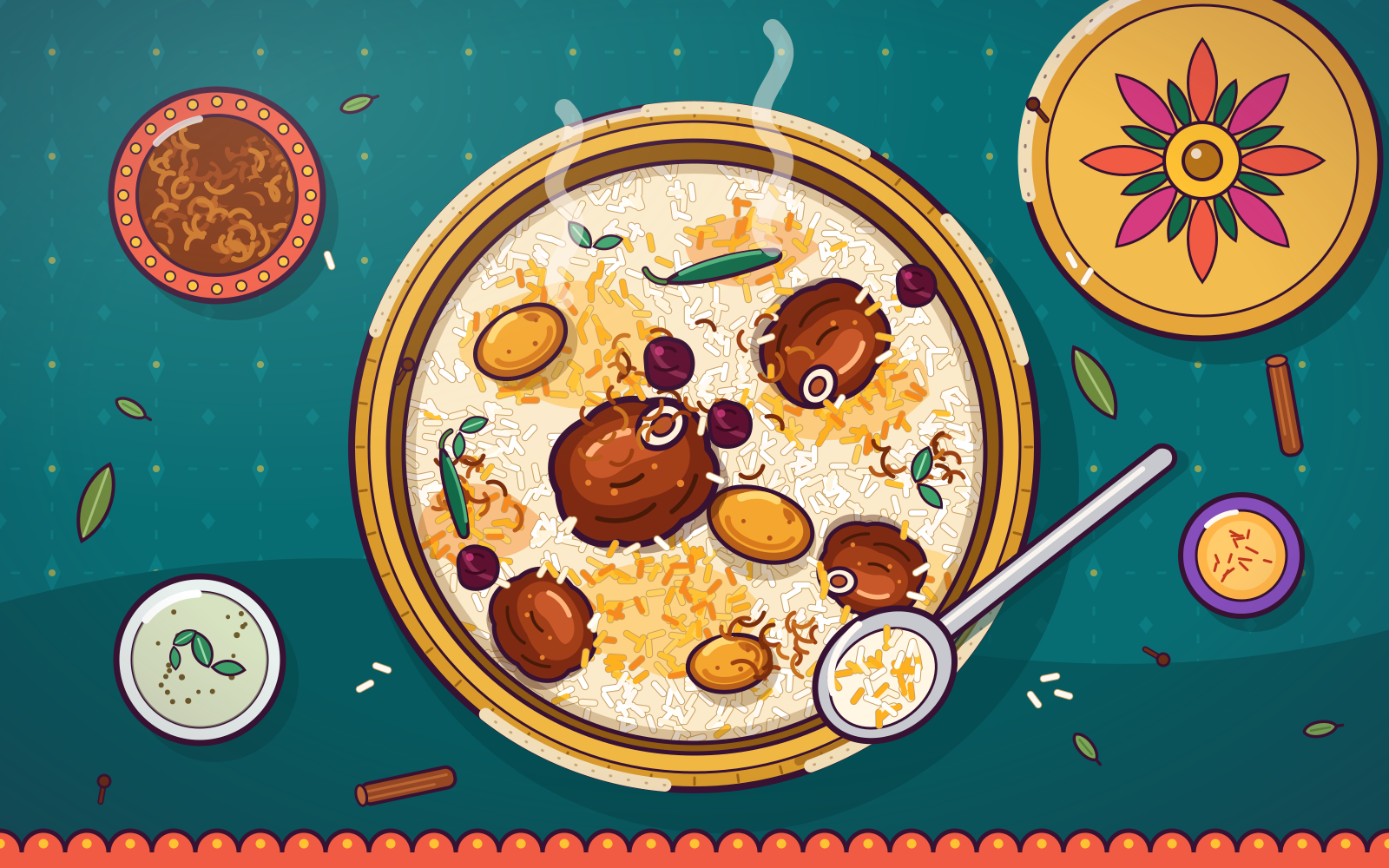
Kacchi biryani is the dish that turns up when a Bangladeshi family means business: Eid, a dawat, a wedding, a walima. The word kacchi means raw, and that's the whole trick. The mutton goes into the pot raw, buried under rice that's only part-cooked, then the lid is sealed and everything cooks together in its own steam. The meat juices rise into the rice, the rice soaks up the ghee and saffron, and the potatoes at the bottom become the thing everyone at the table is secretly counting.
It's also the biryani with the least room for panic, because once the lid is sealed you can't peek. So this guide is less about secrets and more about planning: the right cut of meat, a pot that's big enough, a timeline that starts the day before, and the food-safety habits that matter when a big pot of rice is sitting on a buffet table.
In S's family, kacchi has an owner. She is S's khala, the same khala whose enormous aluminium pot lives on top of a wardrobe and only comes down for engagements and, it turns out, for kacchi. When it's on, the kitchen is closed. Nobody goes in, nobody asks how long, and the only sign of progress is her walking past the hob every so often, tapping the lid twice with her ring and listening. We still don't know what she's listening for. She says it's obvious.
T's family is Sylheti, and Eid at T's mum's meant a pot of beef curry, a pot of polao and a long negotiation over who got the bones. Kacchi was something you met at other people's weddings, lifted out of a foil tray by a caterer. T had strong opinions about it for years without ever seeing one made. The first time was at S's khala's, the year we got engaged. T stood in the kitchen doorway, asked four questions in a row about the dough seal, and was sent to lay the table.
So when we decided to write this up, we knew two things. We'd be cooking for a crowd, because nobody makes kacchi for two. And we'd be doing it without the one person in the family who knows what it's supposed to sound like.
SKacchi is a scheduling problem dressed up as a recipe. Hot rice, meat that's lost its fridge chill and fried potatoes all have to land in the pot within about twenty minutes. Then you seal it and lose all visibility for an hour and a half. In my line of work, that's called shipping without logs.
TAnd what you're aiming for, once the logs come back: grains you can count, some white, some gold, all smelling of ghee. Meat that leaves the bone if you look at it firmly. Potatoes that have sat in the juices so long they taste more of mutton than the mutton does.
SThe only bit we properly fight about is the plums.
TAlu bukhara stays. It's the one sour thing in the pot and it stops the whole thing becoming a ghee coma.
SI eat around them.
THe eats around his and then takes mine.
What makes it kacchi
- Raw meat, not curried meat. Pakki biryani layers rice over a cooked curry. Kacchi layers rice over raw marinated mutton or goat, so the meat and rice finish together.
- A long, gentle dum. The sealed pot cooks on very low heat for well over an hour. The seal traps steam, and the steam does the cooking.
- Birista. Deeply golden fried onions go into the marinade and over the top. They bring sweetness, colour and that unmistakable biryani smell.
- Potatoes. In Dhaka kacchi, a golden fried potato is non-negotiable. They sit with the meat, cook in the juices and come out soft and seasoned all the way through.
- The perfumes: saffron milk, ghee, a few drops of keora (screwpine) water and rose water, and alu bukhara, the sweet-sour dried plums that cut through the richness.
Before you start: the pot, the meat, the rice
The pot
For the quantities below you need a heavy, wide pot of at least 10 litres with a tight lid: a large stainless or aluminium deg, a big cast-iron casserole or a catering stockpot with a thick base. Wide is better than tall, because a shallower layer of meat cooks more evenly. A thin-based pot will burn the meat before the rice is done, so have a heat diffuser or a flat tawa ready to sit underneath it.
The meat
Ask your halal butcher for bone-in mutton or goat cut for biryani: pieces of about 5–6cm from the shoulder and leg, with some fat left on. Lamb works too and cooks a little faster. Keep the pieces evenly sized, because the biggest piece sets the cooking time. Young goat or lamb is far more forgiving here than older mutton.
The rice
Many Dhaka kitchens use kalijira or chinigura, the tiny fragrant Bangladeshi rices, for polao and kacchi. In the UK, long-grain basmati is easier to find and more forgiving in a big pot, because the grains stay separate. Kalijira cooks much faster, so if you use it, cut the boiling time right down (see the method).
We use basmati, and we got there the hard way. Our trial run used kalijira, because S's khala swears by it, and the smell when it hit the water was lovely, sweet and almost nutty. But it went from snapping to soft in what felt like ten seconds, and the layer sitting closest to the meat juices came out slightly mushy. For twelve people, with your nerves already going, an aged extra-long-grain basmati gives you a far wider margin. Save kalijira for polao, or for the day you feel brave.
Ingredients (serves 10–12)
This works out at roughly 170–200g of bone-in meat per person, which is a generous main course with sides. Use the extra 2 portions as your safety margin for second helpings.
Birista (fried onions)
- 1kg onions, halved and very thinly sliced
- About 600ml sunflower or vegetable oil, for frying in batches
- 1/2 tsp salt
Marinade
- 2kg bone-in mutton or goat, in 5–6cm pieces
- 400g full-fat plain yoghurt, whisked smooth
- 2 tbsp ginger paste
- 1½ tbsp garlic paste
- 1 tbsp raw papaya paste (optional, a traditional tenderiser; leave it out for young goat or lamb, and never use more, or the meat turns mushy)
- 2½ tsp fine salt
- 1 tbsp caster sugar
- 1 tsp ground cardamom
- 1 tsp ground white pepper
- 1 tsp mild chilli powder, such as Kashmiri
- ½ tsp ground cinnamon
- ½ tsp ground nutmeg
- ½ tsp ground mace
- ¼ tsp ground cloves
- 1 tsp shahi jeera (black cumin seeds)
- Half of the birista (about 150g once fried)
- 100ml of the oil left from frying the birista
- 8 green chillies, left whole and pierced once
- 12 alu bukhara (dried plums)
Potatoes
- 1kg small or medium waxy potatoes (about 12), peeled and halved
- ½ tsp salt
- Oil from the birista, for frying
Rice
- 1.5kg basmati or kalijira rice
- 6 litres water
- 3 tbsp salt
- 6 green cardamom pods, 2 cinnamon sticks, 4 cloves and 2 bay leaves
Finishing the pot
- ½ tsp saffron threads, crumbled into 200ml warm whole milk
- 150g ghee, melted, plus 2 tbsp for the base of the pot
- 1 tsp keora water (it is strong: measure it, don't splash it)
- 1 tsp rose water
- The remaining birista
- For the seal: 300g plain or chapati flour mixed with about 180ml water into a soft dough, or a double layer of foil
Allergens: contains milk (yoghurt, ghee, milk) and, if you use the dough seal, gluten (wheat). The flour seal isn't eaten, but it does touch the rim, so use the foil seal if anyone at the table is coeliac. Check the labels on shop-bought masalas and pastes.
Method
The day before
- Make the birista. Pour oil into a deep, heavy pan no more than a third full and heat it over a medium-high heat. Toss the onion with the salt, then fry it in 3 or 4 batches, stirring often, for 10–15 minutes per batch, until deep golden brown. Lift out with a slotted spoon and spread on kitchen paper, where it will crisp as it cools. Never leave hot oil unattended, keep pan handles turned inwards and keep water well away from the pan. Keep 100ml of the oil for the marinade and set aside the rest to cool for the potatoes.
- Make the marinade. In a large bowl, mix the yoghurt, ginger and garlic pastes, papaya paste if using, salt, sugar, all the ground spices, shahi jeera, half the birista (crush it slightly in your hands) and the 100ml onion oil.
- Add the meat and rub the marinade into every piece. Tuck in the green chillies and alu bukhara. Cover tightly and refrigerate on the bottom shelf, below anything ready to eat, for 12–24 hours. Wash your hands, the board and anything else the raw meat touched.
- Store the rest of the birista in an airtight container at room temperature. It will keep crisp for a few days.
On the day
- Put the rice water on early. Six litres takes a surprisingly long time to boil on a home hob, often 25–30 minutes. If you don't have one pan big enough, split the water, salt and whole spices between two pans now, and split the rice between them later.
- Take the meat out of the fridge 30–45 minutes before you layer the pot, so it isn't fridge-cold in the middle. Don't leave it out for longer than that.
- Wash the rice in several changes of cold water until the water runs almost clear, then soak it in fresh cold water: 30 minutes for basmati or 15 minutes for kalijira.
- Fry the potatoes. Pat them dry and toss them with the salt. Heat 2cm of the reserved onion oil in a wide pan over a medium heat and fry the potatoes for 8–10 minutes, turning, until golden all over. They should still be firm in the middle, because they finish cooking in the pot.
- Prepare the pot. Spread 2 tbsp ghee over the base of your big pot. Tip in the meat with every bit of its marinade and spread it into an even layer. Nestle the potatoes into the meat in a single layer.
- Boil the rice. Bring the water to a rolling boil with the salt and whole spices. It should taste properly salty, noticeably saltier than soup. Drain the soaked rice, add it, stir once and boil uncovered. Basmati needs about 5–6 minutes after the water returns to the boil, and kalijira only 2–3 minutes. It's ready when a grain snaps between your fingers with a thin, hard white core: roughly 70% cooked.
- Drain the rice straight away and spoon it over the meat and potatoes in a loose, even layer. Don't press it down. The steam needs gaps to travel through.
- Finish the top. Drizzle over the saffron milk in streaks so you get white and gold grains, then the melted ghee, keora water and rose water. Scatter over the remaining birista.
- Seal the pot. Keep the dough soft, almost sticky: a stiff dough cracks in the heat. Pinch off a walnut-sized piece and set it aside for patching. Roll the rest into a long rope, press it around the rim, then press the lid onto it so there are no gaps. Or cover the pot tightly with a double layer of foil and then the lid.
- Start the dum. Put the pot over a high heat for 10–12 minutes, until you can hear the base sizzling hard and see a little steam escaping. This gets the liquid at the bottom boiling quickly.
- Slide a heat diffuser or flat tawa under the pot, turn the heat down to the lowest setting and cook for 1 hour 30 minutes for young goat or lamb, or up to 1 hour 45 minutes for mutton. Don't open it. If the seal cracks and steam starts hissing out, wear oven gloves and press the spare dough over the crack with the back of a spoon. Alternatively, if your pot fits in your oven and the pot, handles and lid are all ovenproof, move it to the oven after the high-heat start, at 160°C (140°C fan), gas 3, for the same time.
- Turn the heat off and leave the pot sealed for 15 minutes, so the rice finishes steaming.
- Check the meat. Open the lid and dig down at the edge to a piece of meat from the bottom layer, ideally the largest one. It should be tender enough to pull off the bone, with no pink juices. A probe thermometer in the thickest piece should read at least 75°C. If it's not there yet, re-seal the pot and give it another 15 minutes on the lowest heat, then check again.
- To serve, use a wide flat spoon and dig straight down to the bottom, so every plate gets rice, meat, a potato and some of the saffron grains. Don't stir it.
What happened when we cooked it
We cooked this twice. The first was a half-size trial for six on a Saturday in October: half of everything, lamb shoulder, kalijira rice, and our own 5-litre casserole. The second was the full pot for twelve, a fortnight later, when both our families came over for Sunday lunch and there was no backing out.
The trial taught us most of what's now in the method. We'd been stingy with the water in the dough, and about forty minutes into the dum it cracked down one side and started whistling like a kettle. S patched it with a spoon and a pinch of leftover dough while T held a phone torch over the pot, for reasons neither of us can now explain. The rice nearest the crack came out chalky. Four tablespoons of hot milk sprinkled over the top and fifteen more minutes on the lowest heat rescued it, which is why that fix is in the troubleshooting list below. Now the dough is soft, and a lump always stays back for patching.
For the full pot we borrowed the khala's deg. It took two of us to get it up the stairs, and on our hob it only fits if you accept that the knob for the next ring is now out of bounds. Its base is thin, so it sat on T's mum's old iron tawa the whole time. The goat came from our halal butcher, cut small, and we left out the papaya paste because the meat was young.
After the high-heat start it had 1 hour 35 minutes on our lowest ring, then the 15-minute rest. When S dug down at the edge, the biggest piece from the bottom came away from the bone with a fork and the probe read 81°C. The potatoes were soft right through. The top was fluffy and separate, with streaks of gold where the saffron milk had gone. A thin layer of rice on the very bottom had caught and gone crisp and brown. Not burnt, just toasted. Two cousins fought over it, so we're calling it a feature.
TCan we talk about the fact that you put an alarm on your phone called Do Not Open The Lid?
SIt worked. Nobody opened the lid.
TNobody was going to open the lid. Your mum was sitting next to the hob like a bouncer.
We didn't hit our own timing plan. We'd shifted it five hours earlier for a 2pm lunch, then forgot that six litres of water on a domestic hob takes forever to boil, even split across our two biggest pans. The rice went in about 25 minutes late. That's exactly what the slack at the end of the plan is for, and lunch went out at quarter past two. The samosas bought us the rest.
Next time, the rice water goes on before anything else, which is now step one of the method. We'd fry the birista with the window open and the kitchen door shut, because the flat smelled of onions until Tuesday. And we'd buy more potatoes. Twelve potatoes, twelve people, and S's dad still asked where the rest of them were.
One honest caveat: we haven't tried the oven route. The khala's deg doesn't fit in our oven, and neither of us fancied finding that out with it full. If you try it, check that everything that goes in, handles and lid included, is ovenproof, and test the meat in exactly the same way at the end.
The timing plan
Work backwards from when you want to eat. If dinner is at 7pm, this is a comfortable plan:
- Day before, evening: fry the birista and marinate the meat.
- 3:30pm: put the rice water on to boil. Wash and soak the rice. Peel and fry the potatoes.
- 4:00pm: take the meat out of the fridge and lay out everything for the finishing layer.
- 4:30pm: boil the rice and layer the pot.
- 4:45pm: seal it and start the high-heat burst.
- 5:00pm: turn it down and start the dum.
- 6:30pm–6:45pm: heat off, rest, then check the meat.
- 7:00pm: serve. Meanwhile make the borhani, salad and anything else.
The 15–30 minutes of slack between checking and serving is deliberate. It covers a pot that needs extra time, or water that won't boil, without guests standing around the kitchen.
Scaling up for a bigger crowd
- For 20–25 people, make two pots rather than one giant one. A huge pot heats unevenly: the bottom can burn while meat in the middle is still undercooked. Two pots cook in the same time as one.
- Cooking time depends on the depth of the meat layer and the size of the pieces, not on the total weight. Don't double the dum time because you've doubled the meat.
- Scale the meat, rice, potatoes, yoghurt, onions and ghee in a straight line. Rice water and its salt scale with the volume of water, not with the rice.
- Go gently with keora and rose water. Above one and a half times the recipe, add them at about three-quarters of the scaled amount. Too much and the pot smells like a department-store perfume counter.
- Keep the ratio of roughly 3 parts rice to 4 parts meat by raw weight. Too much rice and the top layer stays hard, because there isn't enough steam from below.
- Planning for a buffet? Allow about 200g of bone-in meat per person if biryani is the main event, and about 150g if there's a curry and kebabs alongside.
Food safety for a big pot
Big gatherings are where food safety slips, because everyone is busy and the food sits out for a long time. Biryani has two things to watch: raw meat in a sealed pot, and a lot of cooked rice.
- Raw meat: keep it in the fridge, at 5°C or below, until about 30–45 minutes before layering. Keep it covered on the bottom shelf, and keep its marinade and utensils away from salad and anything else that won't be cooked.
- Cooking: because you can't see inside the pot, check one of the biggest pieces from the bottom layer before serving. It should be tender with no pink juices, and at least 75°C in the thickest part.
- Holding: keep the pot covered and hot, above 63°C, if it's going to sit on the buffet. Don't leave it lukewarm for hours. Cooked rice can carry spores of Bacillus cereus, which survive cooking and produce toxins as rice cools slowly.
- Leftovers: cool them as quickly as possible, ideally within 1 hour. Spread the biryani out in shallow containers and put them in the fridge as soon as they're cool. Don't leave the whole pot to cool overnight on the hob.
- Eat leftover rice within 24 hours. Reheat it only once, until it's steaming hot all the way through (at least 75°C in the middle), with a splash of water and a lid on.
- Sending guests home with a box? Pack it once it's cool, and tell them to put it straight in the fridge and eat it the next day.
What to serve with it
- Borhani, the spiced, salty yoghurt drink with mint and green chilli that's the classic Dhaka partner for kacchi.
- A sharp salad of sliced cucumber, onion, tomato and green chilli with lime.
- Jali kebab or shami kebab, and a firni or shahi tukra for afterwards if it's a proper dawat.
At ours, the main table is kacchi, borhani and a big plate of cucumber, red onion and green chilli with lime. That's it. We once added a chicken curry for balance and took most of it home again. Pudding is whatever T's mum brings, which is usually firni, set in the little clay bowls she has been quietly collecting for years.
TBorhani is not optional. It's what makes a third plate possible.
SI don't think that's what it's for.
TThat is exactly what it's for.
Our borhani (serves 12)
This is the version we've settled on after a lot of tasting at other people's houses. It's tangy, salty, a bit peppery and properly green. The black salt (bit lobon, sold as kala namak) has a slightly eggy smell in the packet. That's normal, and it's what makes borhani taste like borhani.
- 1kg full-fat plain yoghurt
- 750ml cold water
- A large handful of mint leaves (about 20g)
- A small handful of coriander, leaves and soft stems (about 15g)
- 2 green chillies, stalks removed
- 2 tsp ground roasted cumin
- 1 tsp black salt (bit lobon or kala namak)
- ½ tsp fine salt
- 1 tbsp caster sugar
- ½ tsp ground black pepper
- Optional: ½ tsp ground yellow mustard seed, for a sharper kick (mustard is an allergen)
- Blend the mint, coriander and green chillies with 200ml of the water until completely smooth.
- Whisk the yoghurt in a large jug until smooth, then whisk in the rest of the water, the herb mixture, cumin, both salts, sugar, pepper and the mustard if using.
- Taste. It should be salty and tangy first, with only a hint of sweetness. Adjust the salt and sugar a pinch at a time.
- Chill for at least 1 hour, covered. Stir before pouring, because it settles. Keep it in the fridge and drink it within 24 hours.
Borhani contains milk, and mustard if you add it. Check the label on your black salt and ground cumin if you're cooking for anyone with allergies.
Troubleshooting
- Rice on top still hard: it went in too undercooked, the seal leaked, or there wasn't enough liquid underneath. Sprinkle 4–5 tbsp hot milk or water over the top, re-seal and give it 15 minutes on the lowest heat.
- Seal cracked and hissing: the dough was too stiff. Patch it with your spare dough and the back of a spoon, wearing oven gloves, and expect the rice near the crack to need the hot-milk fix above.
- Burnt base: the heat was too high or the pot was too thin. Use a heat diffuser next time. Serve from the top and don't scrape the bottom into the platter.
- Meat tough: the pieces were too big or the meat too old for the time. Re-seal and cook longer on the lowest heat, then check again. Next time, ask for younger meat, cut it smaller, or use the papaya paste.
- Rice mushy: it was boiled for too long. Kalijira is especially quick, so pull it out sooner next time.
Our verdict
Is it worth it? For twelve people, completely. For six, only just, and only if you like washing up. It's a two-day job, the pot is half the recipe, and there's an hour and a half in the middle where all you can do is trust the steam. But nothing else we cook gets a table to go quiet like a kacchi does when the lid comes off and the saffron smell hits the room.
Is ours as good as S's khala's? No. We'd like that on the record before anyone in the family says it for us. Hers has decades of practice behind it, and none of it has ever been written down. Ours is the version you can make the first time, from a written plan, without a relative in the doorway. That felt like the point.
SMy verdict: make the birista the day before, put the rice water on first, and keep a lump of dough back for emergencies.
TMy verdict: more potatoes, keep the plums, and don't let him name any more alarms.

Cook it with Jan
Want to make kacchi biryani tonight? Jan will scale it for your crowd and walk you through every step.
- Cooking for a crowd
- Bangladeshi
- Biryani
- Eid
- Make-ahead
- Desi cooking
- Borhani
About the authors
The couple behind Kookbook
Married, British Bangladeshi, and usually arguing about the correct amount of chilli. We test the recipes the internet won't stop talking about, work out what actually tastes good, and share the version we'd make again.